HEFEI, China — A research team led by Professor Ji-an Jiang from the Department of Astronomy, University of Science and Technology of China (USTC) has eported notable progress in the study of Type Ia supernovae. Leveraging the wide-field survey capabilities of the Wide Field Survey Telescope (WFST), also known as the “Mozi” telescope, the team’s findings were published this April in Research in Astronomy and Astrophysics and The Astrophysical Journal.
WFST is a 2.5-meter wide-field optical survey facility jointly developed by USTC and the Purple Mountain Observatory. Benefiting from its deep survey capabilities, it can detect supernovae during their faint, early rising phases, providing crucial conditions for extremely early discovery and continuous monitoring. During its 2024 pilot survey (March–July), the WFST Deep High-cadence ugr-band survey (DHugr) successfully identified 16 Type Ia supernovae in their very early phases. All of these targets were at least 3 magnitudes fainter than their peak brightness at the time of discovery. The bservational data revealed diverse color evolution behaviors within the first 10 days post-explosion. These findings suggest complexities that raditional explosion models may not fully account for, particularly regarding early-phase light-curve diversity. This work, with Ph.D. candidate Weiyu Wu as the first author, was published in Research in Astronomy and Astrophysics on April 17, 2026 (Beijing Time).
In a parallel study published in The Astrophysical Journal, the group presented a systematic observational analysis of SN 2024aedt, a transitional Type Ia supernova discovered during the first night of the WFST’s official survey. SN 2024aedt exhibits properties positioned between normal and sub-luminous (91bg-like) supernovae. The research indicates that while current mainstream Delayed Detonation (DD) and Double Detonation (DDet) models explain certain features, they only partially replicate the supernova’s full observational profile. Furthermore, the temporal spectral evolution reveals that such objects exhibit notable early-phase differences, which may serve as a crucial window for unraveling their physical origins, highlighting the necessity of constructing large-scale early observation samples. This study, led by M.S. candidate Dezheng Meng, was published on April 24, 2026 (Beijing Time).
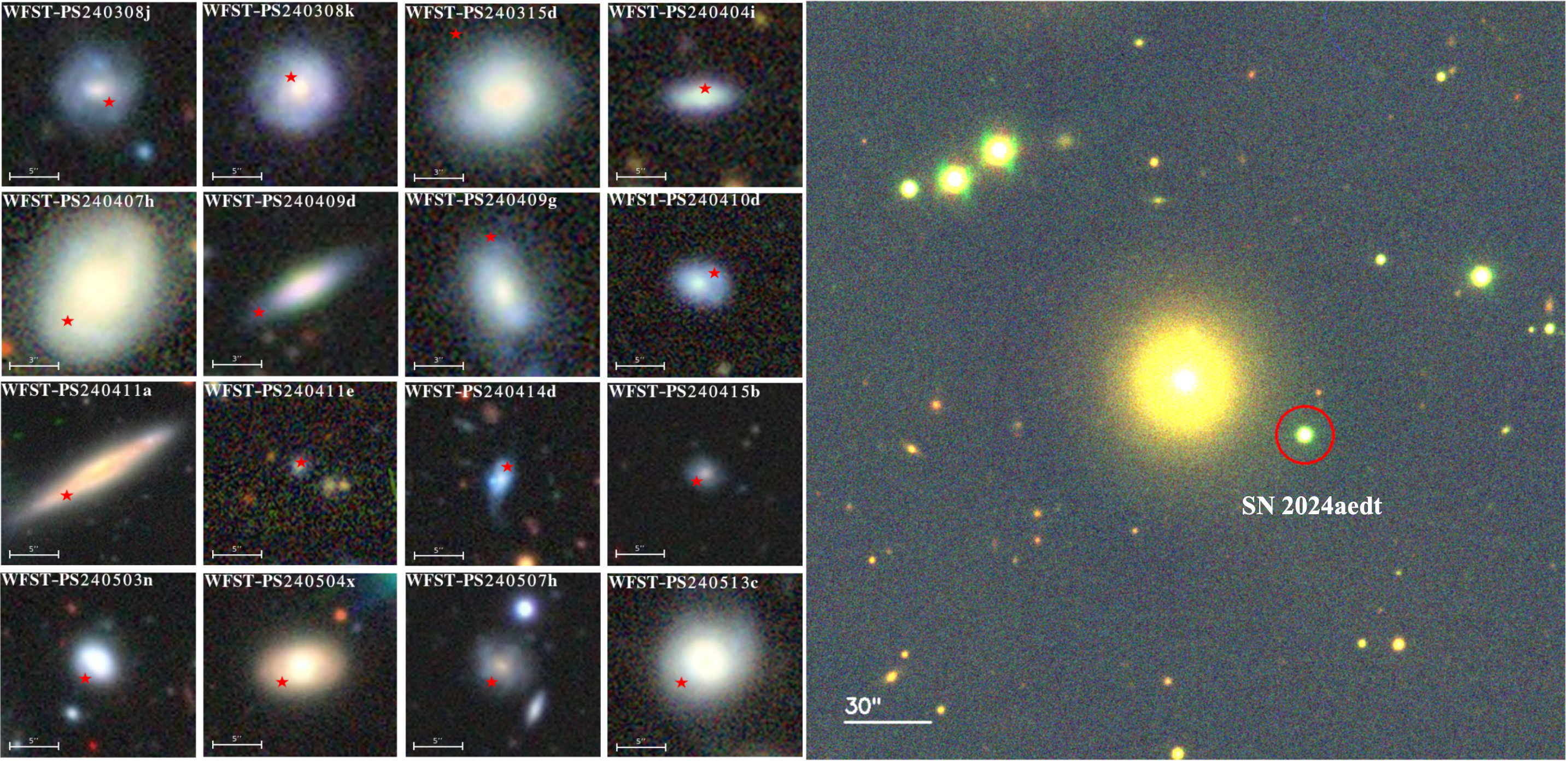
These initial results demonstrate the potential of WFST in the field of time-domain astronomy. Moving forward, the WFST supernova group aims to utilize high-cadence, multi-band data to build a larger sample of early-phase supernovae. Such efforts are expected to further our understanding of the explosion mechanisms and progenitor systems of these mysterious stellar phenomena.
Paper Links:
• https://iopscience.iop.org/article/10.1088/1674-4527/ae4e13
• https://iopscience.iop.org/article/10.3847/1538-4357/ae4c87