AI “Hunter” Precisely Locks onto Black Hole’s Feast: WFST Team Develops Tidal Disruption Event Classifier
Recently, the research team led by Professor Xu Kong at the University of Science and Technology of China (USTC) has achieved a significant breakthrough in time-domain astronomical data mining. Focusing on the massive data from the Wide Field Survey Telescope (WFST), the team successfully developed an automatic classifier for Tidal Disruption Events (TDEs) based on a Transformer deep learning architecture — TTC. Acting like a tireless “AI hunter,” TTC can accurately capture the spectacular moments of a star being devoured by a black hole amidst vast survey data. The results were published on March 10, 2026, in the international renowned astrophysical journal The Astrophysical Journal, under the title “TTC: Transformer-based TDE Classifier for the Wide Field Survey Telescope (WFST)”. Ph.D. student Ranfang Zheng is the first and corresponding author; Ph.D. student Zheyu Lin and Professor Xu Kong are co-corresponding authors.
The Hidden Trail of Black Hole “Feeding”
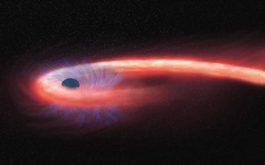
When a star wanders sufficiently close to a black hole, it gets torn apart and accreted by the black hole’s powerful tidal forces, producing a intense flare. This spectacular astronomical phenomenon is known as a Tidal Disruption Event (TDE). TDEs are not only among the brightest fireworks in the universe but also excellent probes for astronomers to detect and study supermassive black holes and intermediate-mass black holes lurking at the centers of galaxies.
With the operation of new generation wide-field survey facilities like the Wide Field Survey Telescope (WFST), humanity is expected to discover hundreds or even thousands of such events annually. However, current automatic screening algorithms often rely heavily on external cross-matching data of host galaxies, leading to TDEs occurring in distant, faint galaxies, extremely active galaxies (such as those with intense star formation, AGN, etc.), or offset from galactic centers being easily missed. How to accurately and quickly find a needle in a haystack from the massive daily influx of light curves is an urgent challenge.
Intelligent Empowerment: Deep Insight from Pure Light Curves
To break this bottleneck, Professor Xu Kong’s team innovatively proposed a comprehensive classification framework (TTC) that does not rely on external galaxy catalogs but solely on the “pure light curve” of the target object for identification. This framework consists of two independently operable core modules:
- Parametric Fitting Module: Quickly performs initial assessments of the light curve shape and color evolution, filtering out a large number of interfering signals. Processing speed is as low as 0.024 seconds per source, significantly reducing computational costs.
- Mgformer-based Deep Classification Network: This is the “smart brain” of TTC. Leveraging the advantages of the advanced Transformer architecture for processing time-series data, this module not only captures long-term dependencies in the light curve but also employs “data augmentation” techniques, enabling it to make accurate predictions even in the early stages of an event (with only a small amount of observation data).
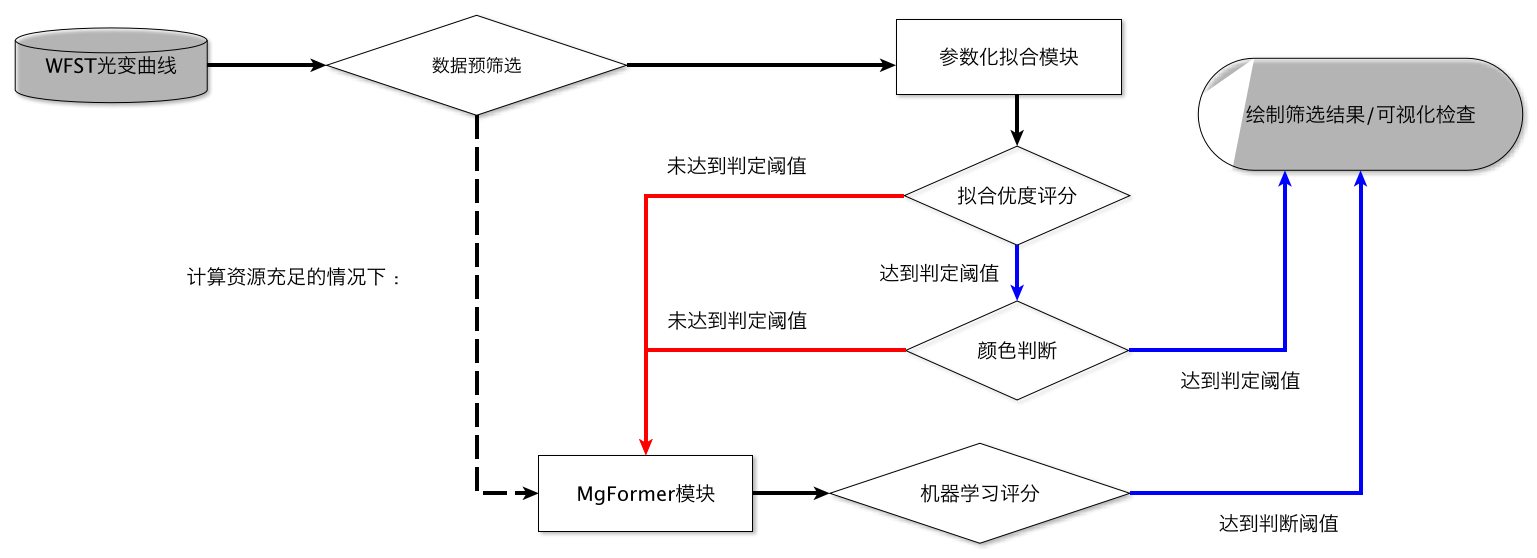
In rigorous tests using nearly 7,500 spectroscopically confirmed transients from ZTF (Zwicky Transient Facility), this AI classifier achieved a recall of 0.79 and a precision of 0.76. Furthermore, the system supports flexible adjustment of classification thresholds to achieve “high recall” or “high precision” goals under different observational resource constraints.
Proven in Action: Early Warning and WFST Deep Mining
In real-time survey data tests, TTC demonstrated remarkable sensitivity. During tests on the first four months of 2025 ZTF data streams, the system successfully identified all spectroscopically confirmed TDEs with 100% accuracy. Remarkably, for the distant event TDE 2025hbw occurring at redshift 0.63, TTC issued an early warning with a high confidence score of 0.98 four days before it was officially spectroscopically confirmed as a TDE, fully demonstrating its significant potential for early discovery of distant, faint TDEs.
Currently, the research team has deployed this algorithm on the deep field survey data of the WFST and successfully screened out about 20 highly promising TDE candidates. With the full establishment of the WFST difference image database and the accumulation of high-quality u-band data (a unique advantage), the discovery rate of TDEs with WFST is expected to increase by orders of magnitude. It is worth noting that this algorithm also showed excellent accuracy in the attached supernova classification task.
This research not only provides a powerful scientific data processing “weapon” for WFST but also offers a reliable Chinese solution for the upcoming era of big data in time-domain astronomy. The project’s research code has been open-sourced on GitHub and Zenodo for use by astronomers worldwide.
This research work was supported by grants from the National Natural Science Foundation of China, the National Key Research and Development Program of China, the Strategic Priority Research Program of the Chinese Academy of Sciences, and the Cyrus Tang Foundation.
Paper link: Ranfang Zheng et al 2026 ApJ 999 181